Academics

Holistic Development: Social, Emotional, Cognitive & Physical
At our school, we follow a holistic development framework that nurtures every domain of a child’s growth.
  • Social Development: Through structured group activities, cooperative play, and peer-led tasks, children learn communication, collaboration, and conflict-resolution skills.
  • Emotional Development: We emphasise emotional literacy, helping children identify, express, and manage their emotions through guided conversations and responsive teaching.
  • Cognitive Development: Age-appropriate, inquiry-based learning strategies foster problem-solving, logical reasoning, creativity, and thinking skills.
  • Physical Development: Fine and gross motor activities are integrated throughout the day to strengthen coordination, stamina, and body awareness.
Image description
Independent Writing Skills
We follow a child-centred writing pedagogy where children are encouraged to write independently without physical hand-holding. Our focus is on building correct letter and number formation, pencil grip, and writing posture. Educators model and scaffold the process, gradually reducing support so that children gain confidence, autonomy, and fluency in writing.
Image description
Individualised Parent–Teacher Meetings
Our One-on-One Parent Interaction Program is designed to provide a 360-degree view of a child’s development. These meetings go beyond academics—they include insights into social behaviour, emotional well-being, motor skills, and classroom engagement. We offer constructive, actionable feedback and work together with parents to create personalised growth plans.
Image description
Development of Healthy Eating Habits
We actively promote independent eating skills and healthy food habits. Children are encouraged to eat on their own—no feeding by teachers—building self-reliance and fine motor control. We request parents to send nutritious tiffins and reinforce mindful eating practices, table manners, and food hygiene at school.
Image description
Emotional Balance & Well-Being
Emotional support is integral to our learning environment. Teachers closely observe children’s moods and provide comfort, reassurance, and alternative tasks when a child appears overwhelmed or low. Our approach ensures that children feel safe, understood, and emotionally regulated before engaging in structured activities.
Image description
Multi-Intelligence-Based Assessment
Our report cards follow the Multiple Intelligences framework, recognising that every child possesses unique strengths. We never force participation in a particular activity; instead, we encourage exposure to diverse experiences and help children discover and pursue their natural interests. Assessments are descriptive, strength-based, and focused on individual progress rather than comparison.
Image description
Child-Friendly Classroom Environment
Our classrooms are designed based on developmentally appropriate environment standards. They are spacious, clutter-free, and offer ample room for movement. Each classroom includes clearly designated spaces—reading corners, free-play zones, art areas, and learning stations—to support different learning styles and activities, making the environment both inviting and stimulating.
Image description
Balanced Daily Routine
The daily schedule is thoughtfully designed with a balance of active and passive activities. We alternate between high-energy sessions—outdoor play, movement activities, music—and calmer experiences—story time, fine-motor tasks, mindfulness moments—to maintain engagement, reduce fatigue, and support natural attention rhythms.
Image description
Teachers Learn, Play & Grow With Children
Our educators actively engage in playful, joyful interactions with children. We believe in co-learning, where teachers participate in activities alongside students, creating a warm, trusting, and positive classroom climate. This approach builds strong teacher–child relationships and enhances student motivation and engagement.
Image description
Activity-Based Teaching Methodology
We follow an Activity-Based Learning (ABL) model, where concepts are introduced through hands-on tasks, manipulatives, games, and interactive experiences. This method promotes experiential learning, strengthens retention, and ensures that children remain active participants in their own learning process.
Image description
First-Hand, Experiential Learning
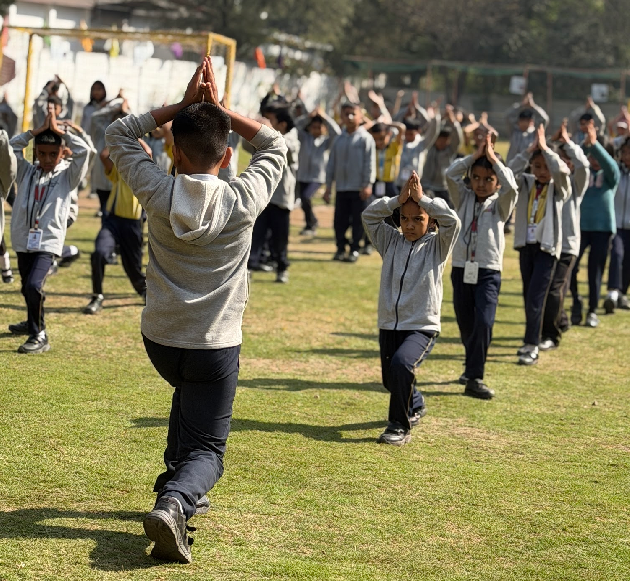
Children learn best when they do, not when they are told. Our teaching practices incorporate first-hand experiences, allowing children to explore materials, observe, experiment, and discover. This sensory-rich approach builds deeper understanding, inquiry skills, and real-world connections.
Image description
Story-Based Concept Introduction
Concepts such as 4-line writing, tens and ones, and other foundational topics are introduced using narrative-based pedagogy. By teaching through stories, we make abstract ideas concrete, relatable, and memorable. Our unique storytelling style enhances comprehension, imagination, and long-term retention while keeping learning joyful and child-friendly.
Image description
Home Activity Kit for Every Child
Each child receives a specially curated Activity Kit to continue learning meaningfully at home—no screens or devices required. The kit is designed to promote active engagement, strengthen fine motor skills, and enhance cognitive development through hands-on materials. It also enables parents to participate mindfully in their child’s learning journey, providing structured, developmentally appropriate activities that reinforce concepts introduced in school. This ensures continuity of learning, independent exploration, and high-quality parent–child interaction.
Image description
Weekly Library Book Program
Each child receives a library book every week to read along with their parents. This initiative promotes early literacy, strengthens vocabulary, and builds a love for reading. The shared reading time enhances parent–child bonding while supporting language development, comprehension skills, and imaginative thinking. Our curated selection ensures age-appropriate, engaging, and enriching stories for every learner.
Image description
Ongoing Teacher Training & Collaborative Planning
Our educators engage in continuous professional development to stay updated with the latest early-childhood teaching practices. We conduct regular training sessions and weekly pedagogical discussions, where teachers reflect on classroom experiences, exchange innovative ideas, and refine instructional methods. This collaborative culture ensures that teaching remains dynamic, research-based, and enriched with fresh strategies—ultimately benefiting every child in the classroom.
Image description

Curriculum Structure as per NEP 2020

Our school functions in complete alignment with the New Education Policy (NEP 2020). The curriculum follows the 5+3+3+4 structure, ensuring a modern, flexible, and learner-centered approach that emphasises holistic development and competency-based learning.

  • In the Foundational Stage, the focus is on play-based, discovery-oriented, and activity-driven learning to build strong literacy and numeracy foundations. 
  • The Preparatory Stage introduces more structured learning, reinforcing reading, writing, languages, mathematics, environmental studies, and basic science through interactive and experiential methods. 
  • The Middle Stage transitions students to subject-based learning with an emphasis on conceptual understanding, critical thinking, arts integration, coding, and hands-on experiments. In the 
  • Secondary Stage students are given flexibility in choosing subjects, enabling multidisciplinary learning, vocational exposure, project-based learning, and deeper exploration of their interests.
  • Across all stages, our curriculum promotes essential 21st-century skills such as problem-solving, digital literacy, creativity, communication, financial literacy, and social-emotional development, ensuring education that is holistic, inclusive, and globally aligned.
  • While English is used as the primary medium of instruction for teachers, we actively encourage multilingual learning for students to enhance comprehension and cultural understanding.
  • As per NEP guidelines, no formal examinations are conducted up to Class 3. However, students’ learning progress is regularly assessed through various activities, oral evaluations, and simple written tasks to ensure conceptual clarity. 

From Class 4 onwards, students follow a structured assessment pattern that includes two Periodic Assessments (PAs), a Half-Yearly Examination, and a Final Examination.